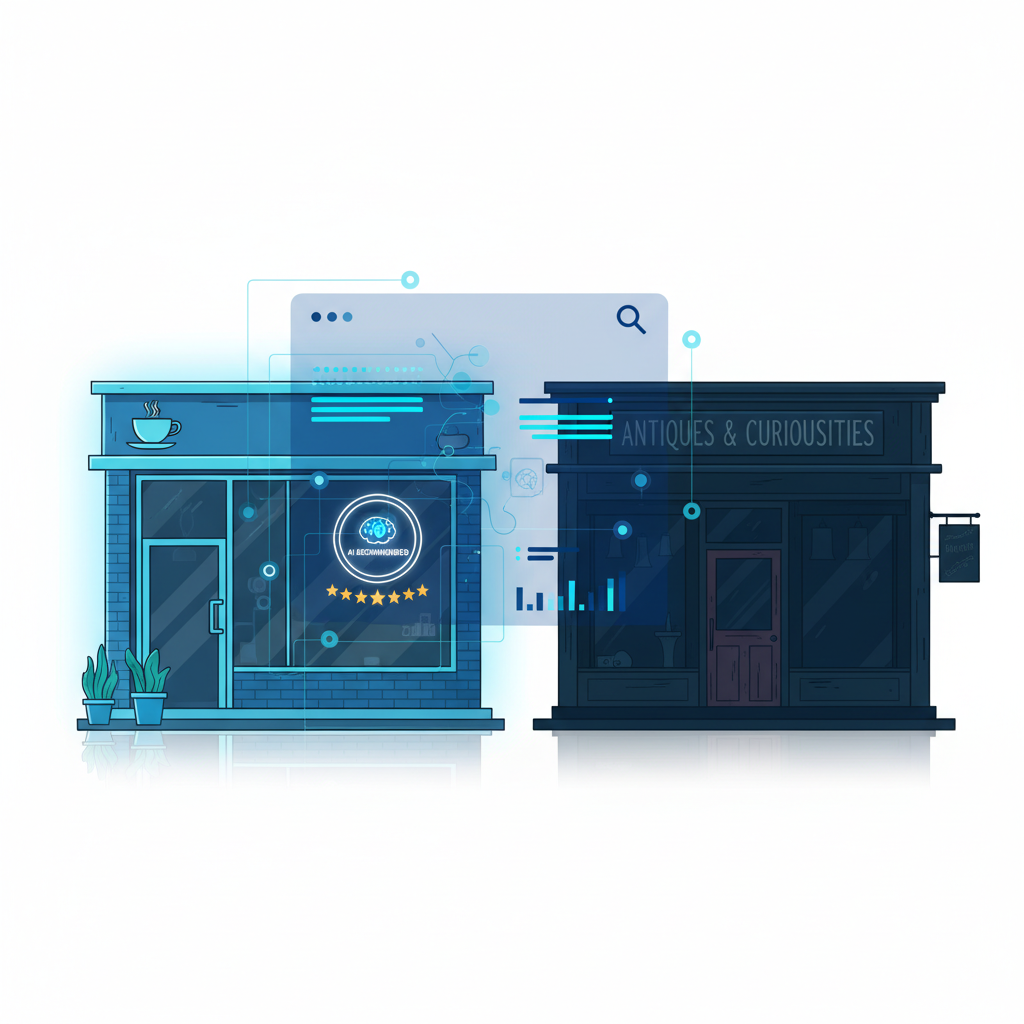
Most content advice for local businesses focuses on the customer — write for the person reading your page, answer their questions, speak to their problems. That advice is still correct. But there’s a second audience you need to write for now: the AI model that decides whether to recommend you before any human sees your page.
That AI model asks different questions than your customers do. It’s not asking “does this business seem trustworthy?” — it’s asking “what evidence exists across multiple sources that confirms this business is what it claims to be?” The distinction matters, because it changes what content you need and how you should structure it.
Understanding the Sub-Question Layer
When ChatGPT Search or Perplexity processes a query like “emergency plumber Parramatta,” it doesn’t return a single lookup result. It fans out — running multiple internal retrievals in parallel before synthesising an answer. These are the fan-out queries covered in our earlier piece.
The practical implication: your content needs to provide clean, direct answers to the cluster of sub-questions the model will ask about your business category. If it can find your answer immediately, your page gets included in the synthesis. If it has to infer, estimate, or work around vague copy, your page gets deprioritised in favour of one that states things clearly.
Here’s how to map this for your own business.
Step 1: Write Down the Decision Questions
Start by writing down every question a potential customer would ask when deciding which business to hire in your category. Don’t filter for what you think is searchable — write down everything that genuinely matters to the hiring decision.
For a residential electrician, this might look like:
- Are they licensed and insured?
- Do they service my specific suburb?
- How quickly do they respond to callouts?
- What do their reviews say?
- Do they specialise in my specific problem (switchboard upgrades, solar installation, EV chargers)?
- What does it cost roughly?
- Have they done work similar to mine before?
This list is not just content ideas. It’s the map of sub-questions the AI model will generate when it fans out on any query about electricians in your area.
Step 2: Check How Clearly Your Site Answers Each One
Go through your website and ask honestly: if an AI retrieved this page in response to each sub-question, would it find a clear, direct answer?
The most common failure modes:
Vague service descriptions. “Electrical services for residential and commercial customers” tells an AI almost nothing specific. “Licensed residential electrician servicing Western Sydney including Parramatta, Blacktown, Penrith, and Hills District” is specific, parseable, and matches multiple geographic sub-queries.
Missing licences and credentials. If you’re licensed, certified, or a member of a trade body, state that explicitly on your site. “All work carried out by a licensed A-grade electrician (Licence No. XXXX)” answers the trust-verification sub-query directly. Many business websites omit this entirely.
No page for the specific service variant. A generic “Our Services” page with a list of dot points cannot match a query like “split system air conditioning installation Brisbane Northside.” A dedicated page titled “Split System Air Conditioning Installation — Brisbane Northside” can.
No direct answer to pricing questions. You don’t need to publish exact prices. But “our callout rate and what we charge for standard jobs” addresses a real sub-question, and avoiding it entirely leaves a gap in your AI legibility.
FAQ content buried or absent. Question-led content is the most AI-legible format that exists. A heading that says “How long does a switchboard upgrade take?” followed by a two-sentence direct answer is a nearly perfect sub-query match. If you don’t have any FAQ content on your site, every competitor with an FAQ section has a structural advantage.
Step 3: Add Content That Closes the Gaps
For each gap you identify, the fix is usually simple: write a short, specific piece of content that answers the sub-question directly.
You don’t need a 2,000-word blog post for every item. A paragraph on your service page, a new FAQ item, a section on your About page that clearly states your licence details and service area — these targeted additions are often more impactful than large content projects, because they close specific retrievability gaps.
A few high-value additions most local businesses are missing:
A service area page for each suburb you cover. Not a landing page stuffed with repetitive copy — a genuinely useful page that explains how you serve that specific area, what work is common there, and how to contact you. The AI Visibility Audit we run typically identifies three to five suburb-level gaps that no page currently covers.
A “Why choose us” section with specific, verifiable claims. “We’ve been in business 12 years, all work is guaranteed for 12 months, and we carry $20M public liability insurance” is retrievable evidence. “We’re passionate about quality service” is not.
FAQPage schema on any page with Q&A content. Publishing question-and-answer content is half the job. Adding FAQPage JSON-LD schema tells AI systems exactly which text is a question and which text is the answer, making it machine-readable without inference. This is something we implement as standard in our AI Search Optimisation service.
Step 4: Think About the Evidence That Exists Off Your Site
Your website is only one source Perplexity and ChatGPT Search will retrieve. The sub-questions about reviews, independent citations, and third-party mentions require evidence that doesn’t live on your domain.
If an AI asks “is this plumber well-reviewed?” and your Google Business Profile has 8 reviews from three years ago, the answer it finds is “not particularly.” No amount of on-site content fixes that specific gap — it requires a review acquisition strategy. Similarly, if an AI asks “has anyone independently verified this business?” and finds no trade association listings, no local press, and no industry body membership, your on-site content is working alone against competitors who have external corroboration.
The map you build in Step 1 is most useful when you extend it to both on-site gaps and off-site gaps. Both matter, and they require different actions. The NAP and citation work we do covers the off-site side; the content and schema work covers the on-site side.
The Compounding Effect
The businesses that consistently appear in AI recommendations aren’t the ones that did one big thing right. They’re the ones that answered the most sub-questions, across the most sources, most consistently.
Each piece of specific content you add, each new review acquired, each new citation built adds another point of evidence the AI model finds when it fans out. None of those individual additions is dramatic. Combined, they produce a digital presence that looks, to an AI retrieval system, like the obviously correct business to recommend.
That’s the goal. Not to game a single query — to build the kind of documented presence that wins across the whole cluster of sub-queries, for every variation of how someone in your service area asks about your category.
If you want a structured analysis of which sub-questions your current presence is already answering well and where the gaps are, start with an AI Visibility Audit. Or reach out directly if you’d prefer to work through it in a conversation.
Questions People Ask About AI Content Strategy for Local Businesses
What type of content does ChatGPT prefer to cite?
ChatGPT Search and Perplexity both favour content that is specific, structured, and directly answers the query without requiring interpretation. This means: clear headings that state the question or topic explicitly, direct answers in the first one or two sentences of each section, factual specificity (actual service areas, real response times, verifiable credentials), and content that exists on a credible domain with external citations pointing to it. Generic, promotional copy — “we’re passionate about delivering quality outcomes” — is not citable. Specific, factual copy — “we service all suburbs within 30km of the Brisbane CBD, with same-day availability Monday to Saturday” — is.
How many pages should my website have to rank in AI search?
There’s no minimum page count, but there is a coverage principle. An AI retrieving content for queries about your business will be looking for specific answers to specific sub-questions. A five-page website that answers ten specific questions clearly will outperform a thirty-page website of vague service descriptions. Start with the sub-questions most relevant to your category — one page per core service, one page per major location you serve, a dedicated FAQ section — and build from there with content that answers real questions your customers actually ask.
Does blog content help with AI search visibility?
Yes, but only if it’s structured to answer questions rather than to tell a story. Blog posts that begin with a clear question heading and answer it directly in the first paragraph are highly legible to AI retrieval systems. Blog posts that open with an anecdote, bury the main point, or use abstract introductions are often retrieved but not cited — the model can’t confidently extract a clean answer. The posts that consistently get cited in Perplexity results are the ones written in an “answer first” format, covering a specific topic with genuine depth.
Should I use headers and bullet points for AI SEO?
Yes. Clear H2 and H3 headings that state the topic (not “Introduction” or “Background,” but “How long does a bathroom renovation take?”) make it easy for AI retrieval systems to match a heading to a sub-query. Bullet points are useful for lists of factual items — services, areas served, included deliverables — where each item needs to be scanned independently. For explanatory content, prose with a direct answer in the opening sentence is often more effective than a bullet list, because it provides context that helps the AI understand the answer, not just the fact. Use both, for different purposes.
Can I use AI to write my content and still get cited in AI search?
You can, but the risk is generic output. AI-generated content that hasn’t been edited with specific, local, verifiable detail tends to produce the kind of vague copy that AI retrieval systems deprioritise. If you use AI to draft content, treat the draft as a starting point and add the specific information that makes it citable: your actual licence number, your specific service areas, the real timeframes your team works to, the specific problems you’ve solved for customers in your area. The specificity is what gets cited. Generic AI copy is rarely the content an AI model retrieves when building a recommendation.